Blog
AI Search Optimization That Ships, Not Scores
AI search optimization means making your site easy for answer engines to crawl, verify, and cite with clear facts, schema, and deployable fixes at scale.
· Updated · 7 min read
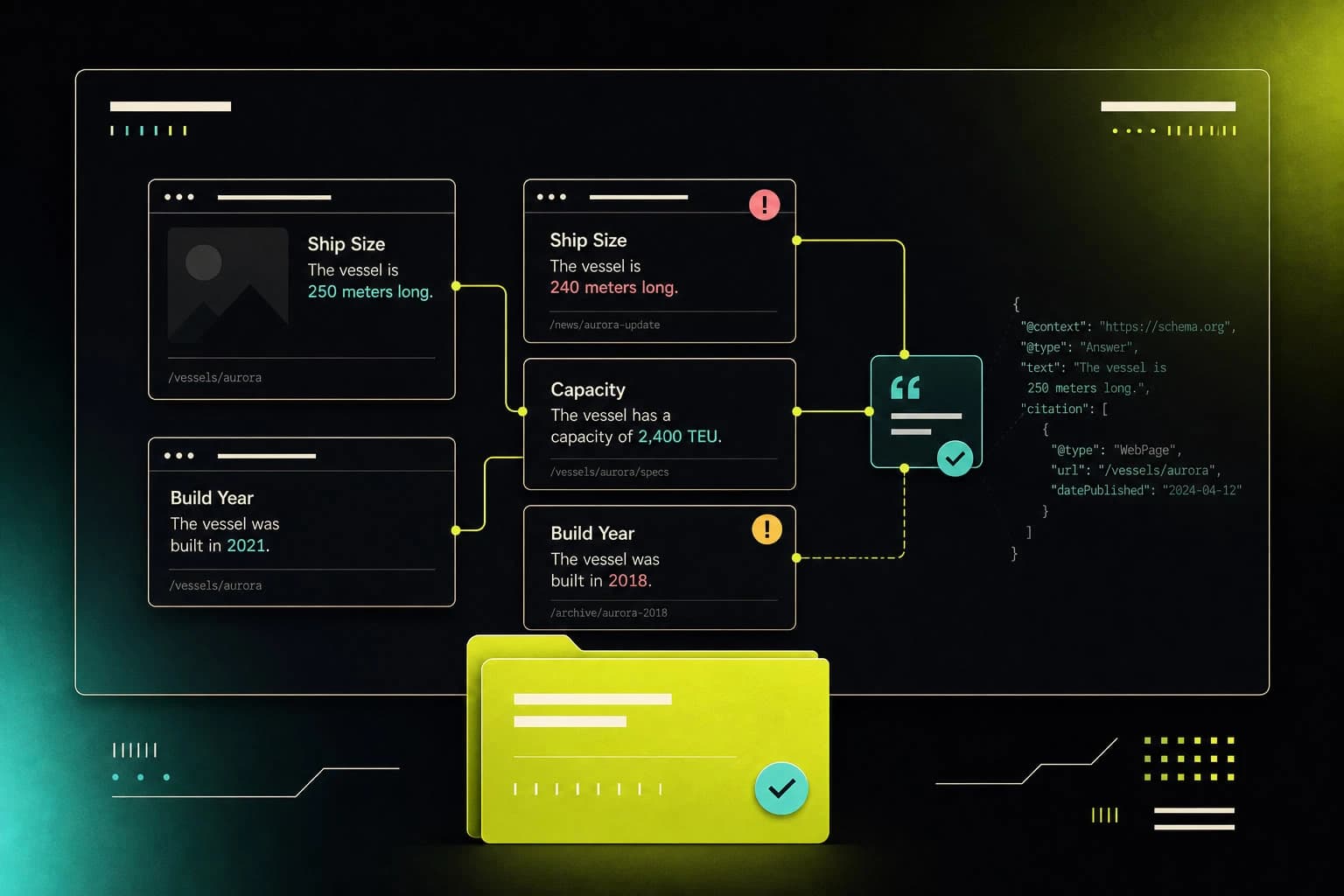
A homepage can look immaculate and still be nearly useless to an answer engine. The pricing details live on one URL, the service boundaries on another, the proof points in a buried case study, and the actual business facts in markup that contradicts the visible page. AI search optimization is the work of closing those gaps so an AI system has reliable evidence to retrieve, interpret, and cite.
This is not traditional SEO with a new label. Rankings are still relevant, but answer engines operate under a different constraint: they need confidence. If your site makes a claim without accessible, consistent, machine-readable support, the model may omit it, hedge it, or replace it with a competitor whose evidence is easier to verify.
The score is the trailer. The evidence is the movie.
What AI Search Optimization Actually Changes
AI search systems do not need your website to sound clever. They need to find stable facts, understand what those facts mean, and reconcile them across the pages they can access. That means the work spans content architecture, crawl controls, technical delivery, and structured data.
A useful way to think about it: conventional search often rewards the best page for a query. AI answers assemble a response from a set of sources. Your brand can lose visibility even when a page ranks well if the system cannot confidently extract the specific fact behind the question.
Consider a buyer asking whether a platform supports SSO, handles multi-location reporting, or serves a regulated industry. A polished landing page full of broad positioning will not carry much weight. A clear feature page, accurate documentation, consistent organization schema, and an accessible pricing or policy page give an answer engine something it can ground.
That is why AI-search readiness cannot be measured from a single URL. Homepage lies. The interior site is where claims either hold up or fall apart.
The Four Jobs Your Site Must Do
Be crawlable without being careless
A bot cannot use what it cannot fetch. Start with the basics: valid response codes, dependable rendering, a current XML sitemap, sensible internal links, and robots directives that do not accidentally block important sections. Then inspect the exceptions. A noindex tag on a key service page, a JavaScript-only navigation pattern, or an overzealous CDN rule can remove useful pages from the evidence set.
AI bot policy belongs in this conversation, but it is not a magic visibility switch. Allowing a crawler does not guarantee citation. Blocking a crawler does not necessarily erase your brand from every answer, since systems may use search indexes or other sources. Set policies intentionally according to your data, legal posture, and distribution goals. Do not inherit them by accident.
State facts where people and machines can agree
Your most valuable facts should appear in readable page copy and be supported by appropriate markup. This includes what you sell, who it is for, where you operate, how customers engage, which products or services exist, and which claims are qualified by date, geography, plan, or eligibility.
Schema helps disambiguate entities and relationships. It does not rescue thin, contradictory, or hidden content. Product schema cannot compensate for a product page that never explains its limits. Organization schema cannot solve mismatched business names, addresses, or social identities. FAQ markup is not a substitute for answering real questions on the page.
The goal is agreement. A human visitor, the HTML, structured data, navigation, and supporting pages should all tell the same story.
Make the site technically trustworthy
A site that loads inconsistently, leaks redirects, serves mixed signals through canonical tags, or exposes weak security headers creates problems beyond security and user experience. It also makes retrieval less dependable. Answer systems favor sources they can fetch, parse, and revisit without surprises.
Technical trust is not one checklist item. It includes HTTPS behavior, canonical consistency, caching, content-type headers, mobile rendering, duplicate variants, accessible HTML, and stable page titles and headings. Accessibility improvements matter here because semantic structure gives machines clearer landmarks while making the site work better for people using assistive technology.
Do not confuse a fast homepage with a healthy website. Check templates, documentation, location pages, blogs, gated-resource previews, and legacy URLs. The page that breaks the answer is rarely the one leadership reviews.
Create evidence, not just positioning
AI systems are especially weak at validating vague superlatives. “Leading,” “best-in-class,” and “trusted” are marketing texture unless your site supplies context. Replace unsupported claims with evidence a buyer and a machine can inspect: methodology, customer criteria, certifications, integration details, named locations, implementation steps, product constraints, and dated research.
This does not mean turning every page into a compliance document. It means placing specificity where decisions happen. If you serve enterprise teams, explain the operational reality. If availability varies by state, say so. If a feature is beta-only, label it. Precision has become a visibility advantage.
Audit the Claims That Matter Before Writing More Content
Most teams respond to AI visibility anxiety by publishing more articles. That can work, but only after fixing the evidence layer. More pages multiply confusion when the underlying site has unresolved canonical conflicts, outdated product facts, or blocked sections.
Start with the questions your buyers, sales team, and support team hear repeatedly. Then map each question to the URLs that should substantiate the answer. For every answer, check whether a crawler can reach the page, whether the page states the fact plainly, whether the markup supports it, and whether another page contradicts it.
The highest-leverage review usually covers these distinct artifacts:
- robots.txt, XML sitemaps, noindex directives, and canonical tags
- navigation paths, internal linking, and orphaned but valuable pages
- organization, product, service, article, and FAQ schema where each is genuinely applicable
- headers, rendering behavior, caching, redirects, and CMS-generated template defects
- AI crawler policies, llms.txt where useful, and the public facts you are prepared to make discoverable
The output should not be a decorative health score or a thirty-page PDF that dies in a shared drive. Each finding needs an owner, a source URL, a clear explanation of impact, and a fix that can be deployed. If the issue is a missing header, provide the nginx configuration or platform equivalent. If it is CMS behavior, define the template change or plugin-level implementation. Not another score. A ship file.
Where Teams Get AI Search Optimization Wrong
The first mistake is treating it as a content-only project. Content matters, but answer visibility is constrained by technical access and factual consistency. A brilliant comparison page cannot help if it is noindexed or rendered in a way critical crawlers cannot process.
The second mistake is chasing every AI crawler. Policies should reflect business intent, not panic. A publisher protecting premium work may make a different call than a B2B SaaS company trying to be cited for implementation expertise. There is no universal allowlist.
The third is publishing an llms.txt file as theater. It can be a useful discovery aid and a concise map of high-value resources, but it does not override robots rules, replace internal linking, or force any model to use your preferred description. Keep it accurate, maintained, and aligned with the pages you want systems to inspect.
The fourth is ignoring competitors. Answer engines choose among alternatives. If a competitor has clearer service pages, cleaner entity signals, and specific proof for the same buyer question, your generic thought leadership may not be enough. Compare claim coverage, not just keyword positions.
Build an Operating Loop, Not a One-Time Cleanup
Websites drift. A redesign changes heading hierarchy. A CMS update adds noindex tags. A new product page duplicates an old one. Legal copy revises service availability while schema stays stale. AI-search readiness is operational because the public web surface keeps changing.
Set a repeatable review cadence around releases, migrations, major content changes, and competitor moves. Crawl beyond the homepage. Track whether priority pages remain reachable, indexable, factually aligned, and technically sound. Re-test after fixes rather than assuming a ticket changed the live experience.
SiteRune is built for this kind of work: crawl the actual site surface, identify page-level failures across SEO, performance, security, accessibility, CMS behavior, and AI-search signals, then turn the findings into deployable remediation. That is a different category from a dashboard that tells you something is wrong and leaves your team to reverse-engineer the repair.
The useful next move is not to ask whether your site is “optimized for AI.” Pick five buyer questions that affect revenue, trace the evidence behind each answer across your site, and fix the first place certainty breaks. That is where visibility starts becoming operational.
Run it on a live URL
Same scan engine. Guest scans stay free.